

Almost no drain clogs the way people think it does. It is rarely one dramatic thing going down the sink. It is months of small stuff sticking to the inside of a pipe until the opening gets narrow enough that the next ordinary thing finally stops it.
The good news is that this makes clogs largely preventable. If you know what actually builds up in a drain line, and what Utah County’s hard water does to that buildup, you can avoid most of the calls we get.
Here is what causes the buildup, what to do instead, and the warning signs that tell you a line is already narrowing.
Grease Is the Worst Offender, and It Is Not Close
Bacon fat, pan drippings, butter, oil, the greasy water off a roasting tray. It all pours as a liquid and none of it stays that way. As soon as it hits the cooler pipe under your sink it begins to cool and cling to the pipe wall.
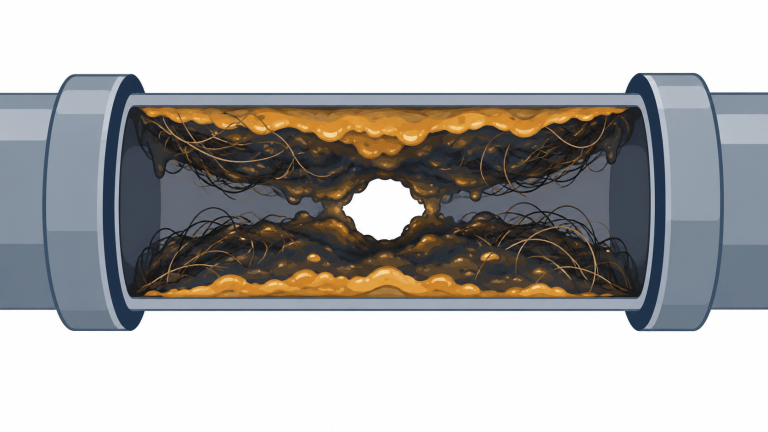
Every subsequent pour adds another layer. The pipe does not clog, it narrows. That is why a kitchen sink that has drained fine for years seems to fail overnight. The pipe has been closing gradually the entire time, and you only notice at the very end.
Two myths worth putting down for good:
- “Hot water melts it through.” Hot water moves grease a few feet further down the line, where it cools and sticks anyway. You have not removed it. You have relocated it somewhere harder to reach.
- “Dish soap breaks it down.” Soap emulsifies grease briefly in the sink. It separates again as it cools in the pipe, and in hard water the soap itself contributes to the deposit.
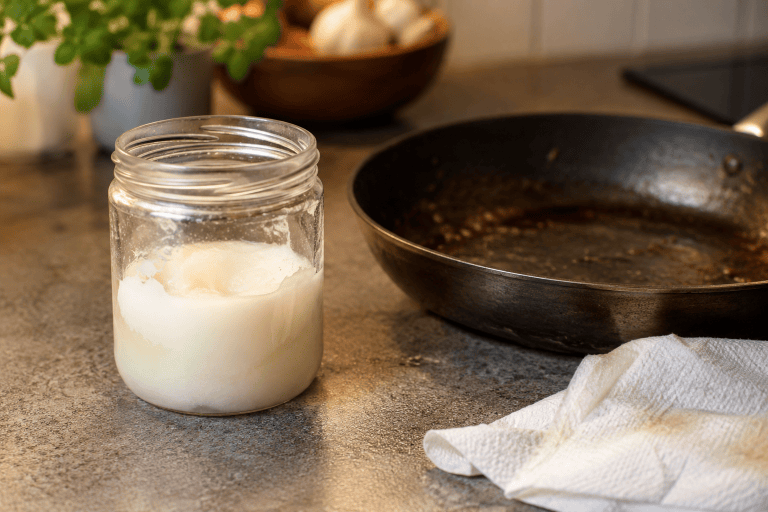
Do this instead: keep an old can or jar under the sink. Pour cooled grease into it, let it solidify, and throw it in the trash. Wipe greasy pans with a paper towel before they ever reach the sink.
Hair and Soap Scum: The Bathroom Version of the Same Problem
Hair on its own would mostly wash through. The problem is what it catches on. Hair snags on any rough spot inside the pipe, then soap scum, conditioner residue and skin oils bind to it. The result is a dense mat that water has to squeeze past.
This is why shower and tub drains slow down so predictably, and why the clog is usually within the first couple of feet of the drain, right where the strainer sits and where the trap turns.
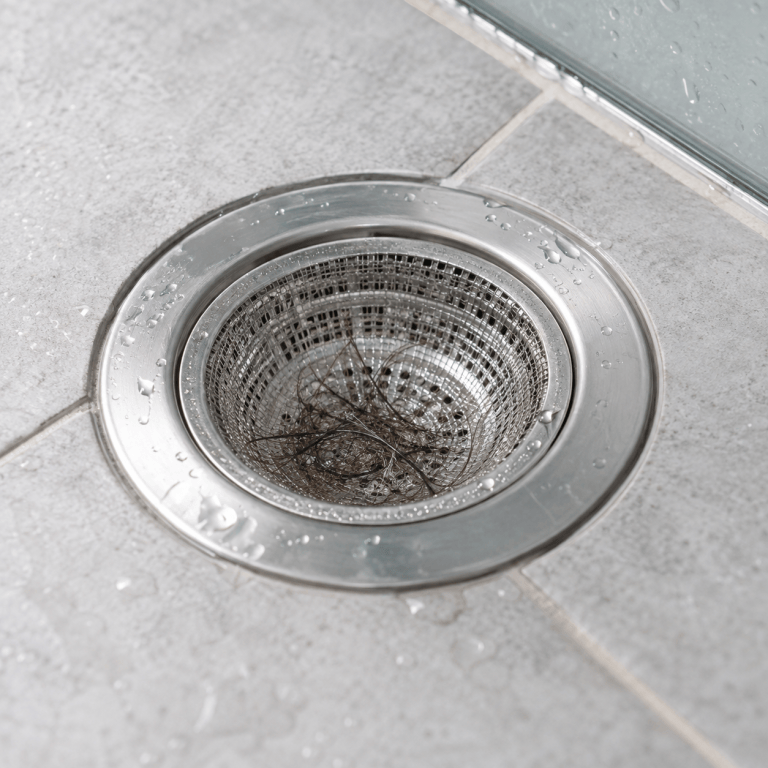
Do this instead: put a hair catcher in every shower and tub. A three dollar mesh strainer prevents the overwhelming majority of bathroom drain calls. Clear it weekly, it takes ten seconds.
Eggshells, Coffee Grounds, and What Your Disposal Cannot Actually Handle
A garbage disposal is not an incinerator. It shreds food into smaller pieces so they can be carried away by water. That is the whole job. If a food does not get carried away, a disposal just produces a large volume of small particles sitting in your trap.
The ones that cause us the most work:
- Eggshells grind into a gritty sand that settles in the trap and mixes with grease to form a mortar-like sludge. The old advice that shells sharpen the blades is wrong twice over: disposals use blunt impellers, not blades, and there is nothing to sharpen.
- Coffee grounds clump and pack down. Anyone who has emptied a French press knows how densely grounds compact when wet. They do the same thing in a trap.
- Rice, pasta and oats keep absorbing water and swelling after they go down.
- Potato peels and starchy scraps turn to a paste that coats the pipe wall.
- Fibrous vegetables such as celery, corn husks, artichoke and onion skins. The strings wrap around the impeller instead of breaking up.
- Flushable wipes are not a disposal issue, but worth repeating: they do not break down like toilet paper, and they are the leading cause of the failed sewage pumps we see.
The simplest rule that actually works: your disposal is for the scraps that get rinsed off a plate, not for disposing of food. Scrape plates into the trash or compost first, and let the disposal handle what is left behind.

Why Utah County Hard Water Makes All of This Worse
This is the part homeowners here tend to miss. Utah County has genuinely hard water, and hard water changes how buildup behaves inside your pipes.
The calcium and magnesium in hard water react with soap to form soap scum, a sticky film that coats pipe walls. That film gives grease, hair and food particles something to grab onto. The same household in a soft-water city would build deposits noticeably more slowly.
It also means mineral scale accumulates alongside the organic buildup, which is why older drain lines in Lehi, Provo, Orem and American Fork often have a hard, crusty interior layer rather than a soft greasy one. That kind of buildup does not respond to the drain products sold at the grocery store.
If you are fighting slow drains throughout the house rather than at one fixture, a water softener is worth considering, not just for your fixtures and water heater but for the drain lines too.
Please Stop Using Chemical Drain Cleaners
We understand the appeal. A bottle costs a few dollars and a service call does not. But caustic drain cleaners work by generating heat and a violent chemical reaction, and that reaction does not distinguish between the clog and your plumbing.
- They can soften and damage older PVC, and corrode metal traps and pipes.
- If they fail to clear the clog, the caustic liquid sits against the pipe wall until someone opens the line.
- They rarely remove the underlying buildup. At best they punch a hole through the middle, so the clog returns.
- They are a genuine hazard to whoever opens that trap next, which may well be you.
If you want something to use monthly, an enzyme-based drain maintenance product is a far better choice. Enzymes digest organic buildup slowly and will not attack your pipes. They are maintenance, not a rescue, so use them on drains that still flow rather than on a drain that has already stopped.
Signs Your Pipes Are Already Narrowing
Buildup announces itself well before it stops a drain completely. Watch for:
- A sink that drains fine at first, then slows as it empties
- Gurgling from a nearby drain when another fixture runs
- A faint sour or sewage smell around the kitchen sink
- Needing a plunger on the same fixture more than once or twice a year
- More than one drain slowing at the same time, which points to the main line rather than a fixture
Two or more drains slowing together is different. A single slow sink is usually a local problem. Multiple fixtures slowing at once suggests the main line, and that is worth looking at with a camera before it backs up into the house.
A Simple Routine That Prevents Most of It
- Every day: scrape plates into the trash, wipe greasy pans with a paper towel, and pour cooled grease into a jar rather than the sink.
- Every week: pull and clean the hair catchers in your showers and tubs.
- Every month: run an enzyme drain treatment overnight in the kitchen sink and any slow bathroom drain.
- Every year: if your home is older or you have had repeat clogs, have the main line inspected before it becomes an emergency.
None of that is difficult and it costs almost nothing. It is the difference between a drain that quietly works for decades and one that needs a plumber every spring.
Slow Drain That Keeps Coming Back?
If a drain has clogged more than once in the same place, the buildup is still in the pipe. We can clear the line properly and tell you what caused it, so you are not doing this again next year.
Utah Valley Plumbing serves Lehi, Provo, Orem, American Fork and all of Utah County.
Schedule Drain Service